Bringing the Flatiron Building's Showpiece Door Back to Life
Zoe Rosenburg | New York TImes
At the headquarters of the International Revolving Door Company in Evansville, Ind., tens of thousands of hand-drawn specifications rendered on onion skin paper in the beginning of the 20th century preserve the early history of a once-novel invention.
These are the archives of the Van Kannel Revolving Door Co., which held the original 1888 revolving door patent from the inventor Theophilus Van Kannel.
And somewhere, presumably, in those documents are the specs for the original wood revolving door at the northeast corner of Fifth Avenue and East 22nd Street, at the base of the Flatiron Building, which was installed in the 1910s. But those specifications are nowhere to be found, said Joshua Kratochvil, the International Revolving Door Company’s eloquent and earnest 34-year-old co-owner — a problem as his company had been tasked with restoring that door in time for a mid-April installation.
The door will serve as the main residential entrance to the triangular 1902 Beaux-Arts landmark in its conversion into luxury condominiums.
When the door was first installed, it represented the height of modernity and cutting-edge engineering. The design allowed for better temperature control and also helped to equalize air pressure in the skyscraper.
By the time the developers from The Brodsky Organization and The Sorgente Group began the project however, the wood revolving door was worn down by use and marked by graffiti. It required a full-scale restoration to return it to its original craftsmanship.
“It’s such a strong visual and historic feature of the building that we wanted to use it,” said Steven Hirschberg, construction manager at the Brodsky Organization.
Part of the task at hand was creating a revolving door with modern-day functionality that was aesthetically identical to the original in order to gain the approval of the Landmarks Preservation Commission that oversees the city’s 1,500 individual landmarks. The project came with a budget in the mid-six figures.
The developers enlisted the International Revolving Door Company, which then brought on Joe Schneider, who worked with one of the Flatiron Building’s previous owners on the door in 2000. That project prioritized function over restoring its original ornate details, according to Mr. Kratochvil. Mr. Schneider came out of retirement to see the door’s restoration done the way he’d always envisioned it.
Figuring out exactly what the door looked like in the early 20th century, without the guidance of the original specifications, came down to sourcing archival photographs and a bit of luck. William Sofield, whose Studio Sofield is designing the building’s residential interiors, found a piece of the door’s original wood canopy — the cylindrical ceiling structure — in the building’s basement.
“One of the things that everyone on the team was very excited about from the start was the archaeology,” Mr. Sofield said. “We went down in the sidewalk vaults — some of them had been sealed up with brick — and we found all sorts of artifacts. We found one of the tiny little sections of the original revolving door ornament thrown in a heap of little parts.”
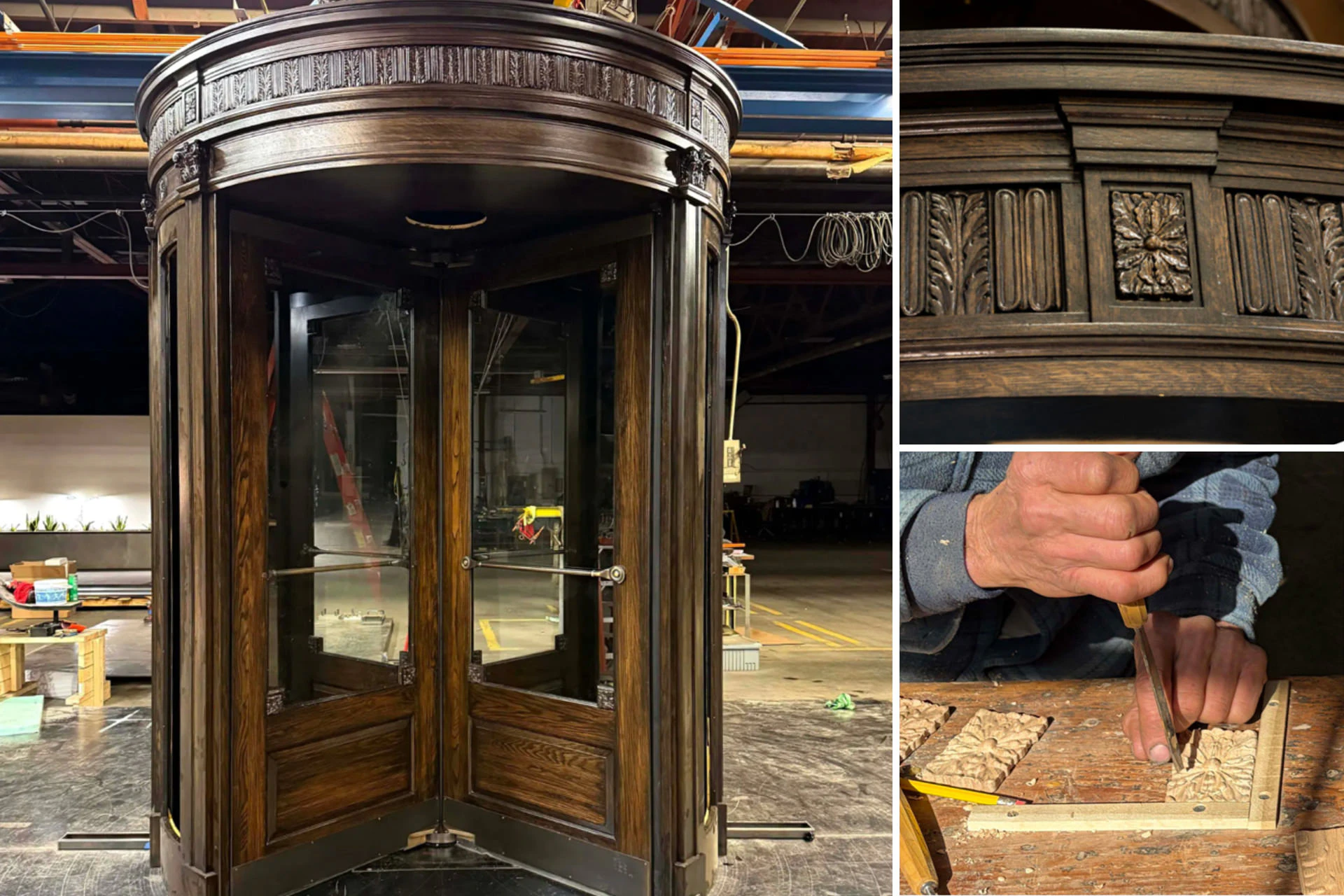
That layer of canopy, removed in the 2000 restoration, was too damaged to repair. After the section arrived in Indiana, workers made a 3-D scan of the original and used a machine to cut a replica from a new piece of white oak. He then carved the details by hand.
“It’s a very, very tedious process to make look correct,” Mr. Kratochvil said.
The rounded wood enclosure and the doors, which both date to 2000, were repaired, sanded and re-stained along with the canopy to match the turn-of-the-20th-century door. The original ornamental cast bronze push bars were stripped, refinished and reinstalled. Mechanisms placed in 2000 and new safety glass make it code compliant for the 21st century.
“In terms of the scale of the project, to be honest, I knew I wouldn’t even have tackled it without knowing someone like Joe was there, because he’s a master mill worker,” Mr. Kratochvil said of Mr. Schneider. It’s a project that required the craftsmanship and trade knowledge of a bygone era, he said.
This week, the restored revolving door returned to its home at the corner of Fifth Avenue and East 22nd Street. “The Flatiron Building” is detailed in subtle lettering quietly announcing the residences. It was important to the developers to honor the building’s history and its contributions to New York, in spite of its wholesale interior remaking. “We’re not keeping the building, we’re selling it — it’s a residential condominium,” Mr. Hirschberg, of the Brodsky Organization, said, “but for our little slice of time when it’s in our custodianship, we’re trying to ensure that the work we do will last many, many years.”