Corcoran Sunshine Marketing Group’s Kelly Kennedy Mack Can’t Slow Down
Larry Gelten | Commercial Observer
Manhattan native Kelly Kennedy Mack, president of Corcoran Sunshine Marketing Group since 2006, had been to Europe around 20 times already by the time she was 10 years old.
Growing up in Peter Cooper Village with a father who was a sales and marketing executive for Pan Am, it now seems clear that Mack was destined to be constantly on the go.
“I love to travel. Now that I have children, I love to take them traveling whenever we can,” said Mack, 52, who lives in Midtown West with her husband, Stephen Mack, co-founder and managing partner of Solon Mack Capital, and their two daughters, ages 7 and 9. “[As kids], my sister and I were always adaptable. We always had the ability to make new relationships and meet new people. We were around a lot of grown-ups and a lot of different cultures and ideas. We went everywhere.”
This wanderlust translates to her current everyday life in New York City, which can find her walking five to seven miles a day checking on her various residential projects. Corcoran Sunshine Marketing Group’s internal tracking of Manhattan residential sales places it at No. 1 among firms specializing in marketing and selling newly built homes, with sales of around $3 billion each year from 2021 through 2025 and over $65 billion in sales over the life of the company. Its work on Hudson Yards alone resulted in 428 sales totaling over $2.5 billion, according to the firm.
Mack estimates that the company represents around 30 to 40 projects at any one time, and that so far in 2026 it has represented around 40 percent of the sponsor sales in Manhattan by dollar volume. (Sponsor units are new, never-before-sold homes.) Asked to mention a few of Corcoran Sunshine’s current and upcoming projects, Mack recites a litany.
A partial list includes Legion Investment Group and EJS Group’s Greenwich Spire at 11 West 13th Street, with two- to five-bedrooms starting at $4.5 million; Legion’s 550 West 21st Street, designed by Thomas Juul-Hansen, with one- to four-bedrooms topping off at over $30 million; Legion and Nahla Capital’s 1122 Madison Avenue, which has sold out its 26 three- to fivebedrooms save for two remaining five-bedroom residences starting at $38.75 million; Vanke U.S.’s Selene at 100 East 53rd Street, with residences designed by Sir Norman Foster, with studios to four-bedrooms from $1.6 million to $29 million; and JVP Development and Gamma Real Estate’s Sutton Tower at 430 East 58th Street, also designed by Juul-Hansen, with onebedrooms to penthouses from $1.825 million to $65 million.
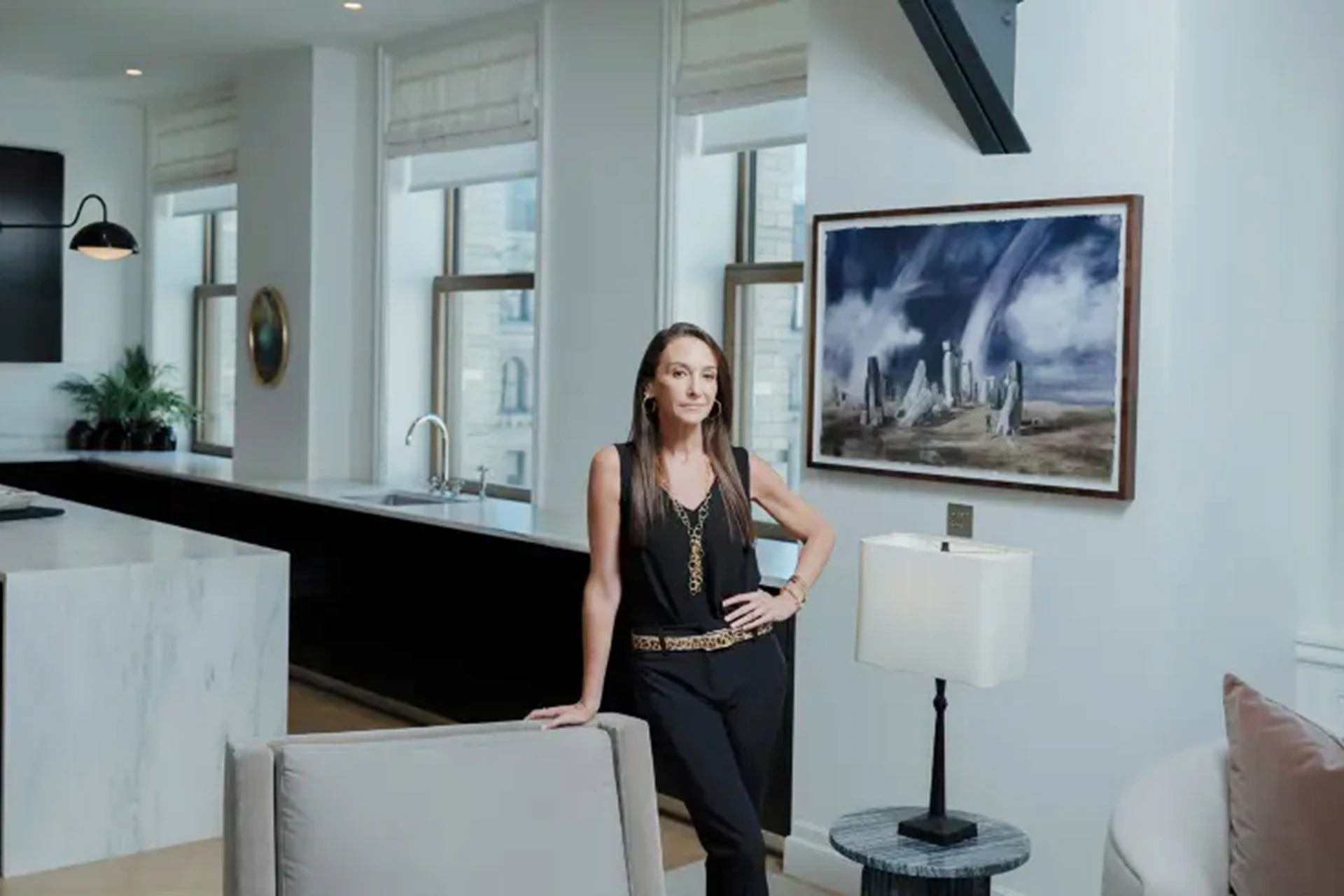
Then there is the Flatiron Building, recently converted to residences for the first time in the building’s 124-year history, which is where Commercial Observer spoke with Mack, freshly recovered from a cracked fibula suffered in July during a padel game on Long Island. While the elaborately furnished unit we spoke in is not yet on the market, the similar unit across the hall is currently priced at just under $18 million.
This interview has been edited for length and clarity.
Commercial Observer: Tell us about your upbringing.
Kelly Kennedy Mack: I went to public school in Chinatown in a gifted program until I was in fifth grade, when my parents moved me to the Dalton School, where I was captain of the basketball and volleyball teams. I met my husband there. We started dating when I was 15 years old. We just celebrated our 25th wedding anniversary last week.
Growing up in the city was amazing. We did a lot of fun things as New York City kids. We went to every Knicks and Yankees game, and took advantage of pretty much everything New York had to offer.
My mom did real people casting for TV commercials. My sister and I actually wound up in a Tide ad. There were pictures of us in every washing machine sold for like four or five years.
Did you have a business orientation early on?
I had a job at a very young age. We were lucky enough to summer in the Hamptons before it was “The Hamptons.” Around seventh grade, I started working, along with my sister and our cousin Jeff, at the Sagaponack General Store. We worked really long days, from like 7 in the morning until 7 at night, and I did that for many years. Me and my sister developed a work ethic at a very young age that has stayed with us.
Tell me about your earliest professional experiences.
I graduated from Georgetown, then came back to the city wanting to work in TV and entertainment. I worked at Turner Broadcasting doing ad sales and marketing for Cartoon Network for a couple of years during the time of “Dexter’s Laboratory” and “The Powerpuff Girls.” I loved it, but I wanted to get more involved in big picture corporate strategy. I applied to business school at New York University, but I was rejected. It was one of the first times in my life I was flat out rejected for anything, which was tough to take. But I reapplied the next year, got in, and got my MBA at NYU’s Stern School of Business.
A year later, Stephen and I got married over Labor Day weekend, and then 9/11 happened. The business world changed. All the media companies moved to California. I wasn’t moving to California, so I started to re-evaluate.
My husband’s family was in real estate. I had been very close with my father-in-law [William Mack, co-founder of Apollo Real Estate Advisors] for many years because I’d been part of their family since I was 15 years old. At the time, he was co-developing Time Warner Center [now Deutsche Bank Center] with Related. He was working with this woman named Louise Sunshine. He said she was one of the smartest people he’d ever met, and he thought we should meet.
This was the Sunshine Group, the first iteration of the company we have now. Louise had founded it. At the time, she was doing the marketing and sales for Time Warner Center.
I went to meet her. She kept me waiting for about two hours and kept forgetting I was there. Finally, I walked into her office. She looked me up and down. We talked for about 35 seconds, and she’s like, “All right, this looks good. You should come work for me. I just sold my company to NRT. I’m looking to expand.” I said, “I know very little about your business but I’d love to learn about it. Before I say yes, I’ll join you unpaid for now. Let me get exposure to the company.”
We did that for a couple of months, then she turned to me one day and said, “It’s about time you start getting paid.” People in the company joke to this day that I was one of the most overqualified unpaid interns the company’s ever had. I went from unpaid intern to vice president of business development in basically 24 hours. [Actually, more like a few months.]
What were your duties as intern-turned-VP?
As vice president of business development, I had a few responsibilities. To bring in new business, including pounding the pavement, making phone calls, and finding new opportunities — which I still do today.
And, I wanted to set up an infrastructure or distribution network that took advantage of our conglomerate ownership at NRT. I envisioned a world where we went into other markets to present properties rather than just have them come to us. I traveled all over the country for that.
Plus, we had zero business infrastructure, so overnight I became the finance person, negotiated agreements with clients, helped with research and events. Wherever we needed help, I would say yes.
What was it about the position that made you think this should be your long-term career?
It was nonstop excitement. I’m not a person who sits down for very long. I like a lot of movement, I like to be challenged, and I like the autonomy to figure out how to do things on my own.
Louise was incredibly busy, and I have endless stories about how she would say, “Go set this up, go do this.”
I set up this big meeting for her and I to fly to Las Vegas to pitch representing this huge condo development to the chairman of MGM. I’m at the airport and I get a call from Louise’s assistant, who’s like, “She’s gonna miss the plane. She’ll meet you in Vegas.”
Well, Louise couldn’t make it. I was terrified. I was 20-something years old, walking in to meet the chairman of MGM. We didn’t get the business, but it didn’t matter. I threw myself in head first, terrified or not, into any situation, with very little support. It gave me exposure to every side of the business.
How did you evolve into company president so quickly?
I spent two years as vice president of business development, then another two as executive vice president. Then, our parent company decided to combine the Sunshine Group and Corcoran Group Marketing and put them under Corcoran.
Louise became chairman emeritus, and they were looking for a president. They went through several candidates over about a year. Then they came to me. The head of NRT asked me to take the position. I said no. I saw three people walk in and out within a year. I thought, “This can’t be good.”
But the third time they asked, I said yes, with conditions, including that I’d need a full-time attorney and some business infrastructure.
Talk about some of the key steps you took as president to grow the company. We were the first company that created specialization in the new development landscape. We built out a world-class planning and design team of architects who could weigh in on layouts in the pre-development phase.
We built a huge research team that is still renowned today.
We continued to invest in and build out our marketing and sales teams, including with dedicated on-site sales teams.
It was that structure which truly set us apart, which we still very much have today. Over the past 20 years, it’s a combination of that structure and the culture, our people, that has allowed us to stay dominant in the industry all these years.
Talk about the nature of your involvement in a project’s earliest stages.
Very often, we are brought in before our clients even buy the dirt. Their first call is to me or one of my senior team members. They say, “We’re looking at this deal. What do you think? How much do you think you could sell it for? Who’s going to buy here? Would it be better as rentals or condos?” It’s a consulting feasibility type of conversation.
A lot of our input is data driven, and a lot comes from our 20-plus years of experience in understanding the nuances of the market, including what’s changing, what buyers are looking for, where prices are headed — a confluence of factors.
We work with most of the large-scale developers in the city, so we’re having those conversations every day. We’re also making introductions and creating partnerships between financial partners and developers.
Larry Silverstein is a perfect example. When he was first doing what is now known as 30 Park Place [the Four Seasons Hotel New York Downtown, which combines 157 luxury residences and a 189-key hotel] he asked what I thought he should do there. He was thinking about whether he should put in a hotel. Before I walked in, it was a different hotel brand than the one we wound up with. When we walked out, it was Robert Stern’s first residential building downtown, and it was a Four Seasons.
Are you personally involved in all of the company’s projects?
I personally touch all of them. I have a very large senior management team that has built this company with me from the start. One of the things that’s unique and special is that about 40 percent of our team has been with the company for longer than 10 years, 25 percent for more than 15 years and about 12 percent for more than 20.
Myself and five or six managing directors run our property portfolios. Each one runs about four or five projects at a time. So this is not a company that was built by Kelly Mack. This is a company that was built with every person that has been here with me from day one.
Corcoran Sunshine Marketing Group is No. 1 in the market. How important to you is that status, and how does it impact the firm’s approach to business?
Being No. 1 is important to us. There’s no question. We all take great pride in continuing to be No. 1.
There’s always somebody chomping at our heels, somebody who’s trying to win business or steal our clients. Being No. 1 doesn’t take priority over the actual work, which is doing the right thing by properties and clients. But being steadfast and relentless in that pursuit is probably what continues to make us No. 1. We certainly don’t take it for granted. We don’t have any level of complacency, ever.
Part of our status is, I think, that we work harder than everybody else. There’s a level of experience, professionalism and judgment required in both good markets and difficult ones. There’s no shortcut for that, and it’s not easy to replicate. So it’s very hard for people to catch up.
We appreciate our past, but we’re always looking at what’s next. We don’t rest on our laurels. In both challenging and difficult times, when many people have had to close shop, we’ve repositioned. Have we ever had to get a little smaller? Sure. But we are 100-plus people strong, and most of them have been here 10 to 15 years. We hold onto most of the team year after year, and the way we’ve done that is that in bad markets we look for new opportunities. We find new ways to create value and deliver on our market authority proposition. For example, back in 2009, during the Global Financial Crisis, we leaned in deep to our research and analytics team and made presentations to banks all day. The banks became our clients, and those relationships have lasted.
What’s the latest example of where you took the company in a surprising new direction?
Over the past 20 years, the vast majority of our focus has been in New York City. What has really changed over the last few years is that we started to expand our footprint. It used to be maybe 5 percent of our business was out of New York City. Now it’s close to 30 percent, and I see that growing substantially.
We’re working on properties in L.A., Newport, Toronto, Atlanta, Nashville and the Bahamas, and we’re very close to something in Austin. We have really beefed up the consulting side of our business.
We’re working on large-scale master-plan consulting and positioning on a global level, including in Hawaii and Seoul.
Given the inventory landscape in New York City over the last five-plus years, we’ve been proactive about figuring out alternative revenue opportunities to make sure we’re keeping the team together.
The biggest challenge right now in New York is the lack of new property introductions. This has been building post-COVID for a combination of reasons. It’s not that the demand isn’t there — demand is outstripping supply. Last year had the smallest amount of new development units introduced to the market in 20-something years, and inventory has been shrinking every quarter for the last 13 quarters. We already represent more than 40 percent of the market, so it’s not that we’re not doing our job and bringing in business. There’s just not enough business in New YorkCity.
Many of our clients who have developed in New York City for many years are no longer interested in developing here. They’re going into other markets and they’re asking us to go with them, because there’s not a company like ours that has years of trust and relationships built in that could deliver the types of services we deliver.
Also, we are part of Corcoran, which has a franchise business and also recently merged with Compass, so they’re in tons of different markets around the country. This has allowed us to take our expertise, find the right local partners, and be able to offer the whole package.
After the election of Mayor Mamdani, there was a lot of talk about the wealthy fleeing New York City, which was then exacerbated by the pied-à-terre tax and the mayor’s comment on Ken Griffin. As familiar with the luxury market in New York City as you are, do you see the wealthy really leaving or disinvesting from New York City?
Mamdani’s comments on Griffin and his 220 Central Park South home were really uncalled for. We were lucky enough to have worked on that project with Vornado CEO Steve Roth from the beginning, and we sold that apartment to Ken. That apartment broke every record. You don’t call out a private citizen on social media like that, especially one who’s contributing so many tax dollars and does so much for charities and the city.
But, politics aside, over 20 years, there are so few moments when I remember everything just being perfect. There’s always something, whether it’s the financial crisis, mortgage rates, the first pied-à-terre tax discussion, a war, an election, COVID — almost never a year goes by without there being something that creates significant headwinds for the market.
New York City is an incredibly resilient place. It bounces back. There have been some pretty scary times when there were months where nothing was happening, COVID being a great example. But, coming out of COVID, we saw one of the strongest real estate markets in New York history, almost overnight, because of all the pent-up demand.
So we get a new mayor. People aren’t happy about the new mayor. Everyone says they want to leave. Many people actually did leave and went to Florida for tax reasons, and they moved their businesses to Florida as well. Many of them kept their apartments in New York, but that was OK because they were just apartments in New York. But now they have the pied-à-terre tax.
What I would say to answer your question is: I don’t know yet. Let’s see. It seems like there’s a lot more complaining going on than actual action. When you look at the data, we are not seeing any effect whatsoever as of yet. We’re seeing pied-à-terre purchasers still purchasing, but not at the same level, and not as many at higher price points. But they’re still very much here. Overall, the market is not taking a hit.
But the real question is: How much stronger would the market be if that segment of the market was as strong as it should be right now? The market’s exactly the same. It hasn’t gone down at all. But I believe the market would be way up, because we’ve chipped off some piece of the pied-à-terre market, and we’re also at tremendously low levels for international buyers than we’ve ever seen before.
What are luxury buyers looking for in residential properties today. What’s trending?
Well-designed layouts, incredible finishes, high ceilings, light, views — all of those are a given these days. That’s a baseline expectation. And they all still want amenities — whatever a building can support.
But they’re also looking for an overall lifestyle experience. They don’t just want these amenities. They want them programmed. They want experiences and life in these buildings, which has led us into another era of how we market and promote developments in creating strategic partnerships early in the sales and marketing stage about programming, whether it be art, culture, health and wellness, gastronomy, retail, restaurants, service, hotel groups. A lot of people want five-star hotel service, but they don’t necessarily want a hotel.
With so much going on at work, do you have any time for hobbies?
I don’t have that much free time. I dedicate a lot of my time to NYU. I’ve been on the board of the university for 15 years, and I’m now the executive vice chair, so I’m deeply engaged with everything that happens there. That’s like a full-time job, but I get so much personal satisfaction from being part of that community.
I’m also vice chair of the board of my kids’ school. My husband says I have to stop saying yes. I’m a yes person, though. I need to say no, but I’m a lean-in kind of person. And I still love to travel. I took my kids to Rome and Florence this summer, and I think we’re going to Japan in March.

