15 things you didn't know about the Flatiron Building
City Realty
For more than a century, the Flatiron Building has stood at the meeting point of Broadway, Fifth Avenue, and 23rd Street, turning one of Manhattan’s most awkward parcels into one of its most recognizable silhouettes. Completed in 1902 as “The Fuller Building” for its developer-builder and designed by Daniel Burnham of Burnham & Root, the 22-story steel-framed tower rose at a moment when New York City was just beginning to embrace the skyscraper.
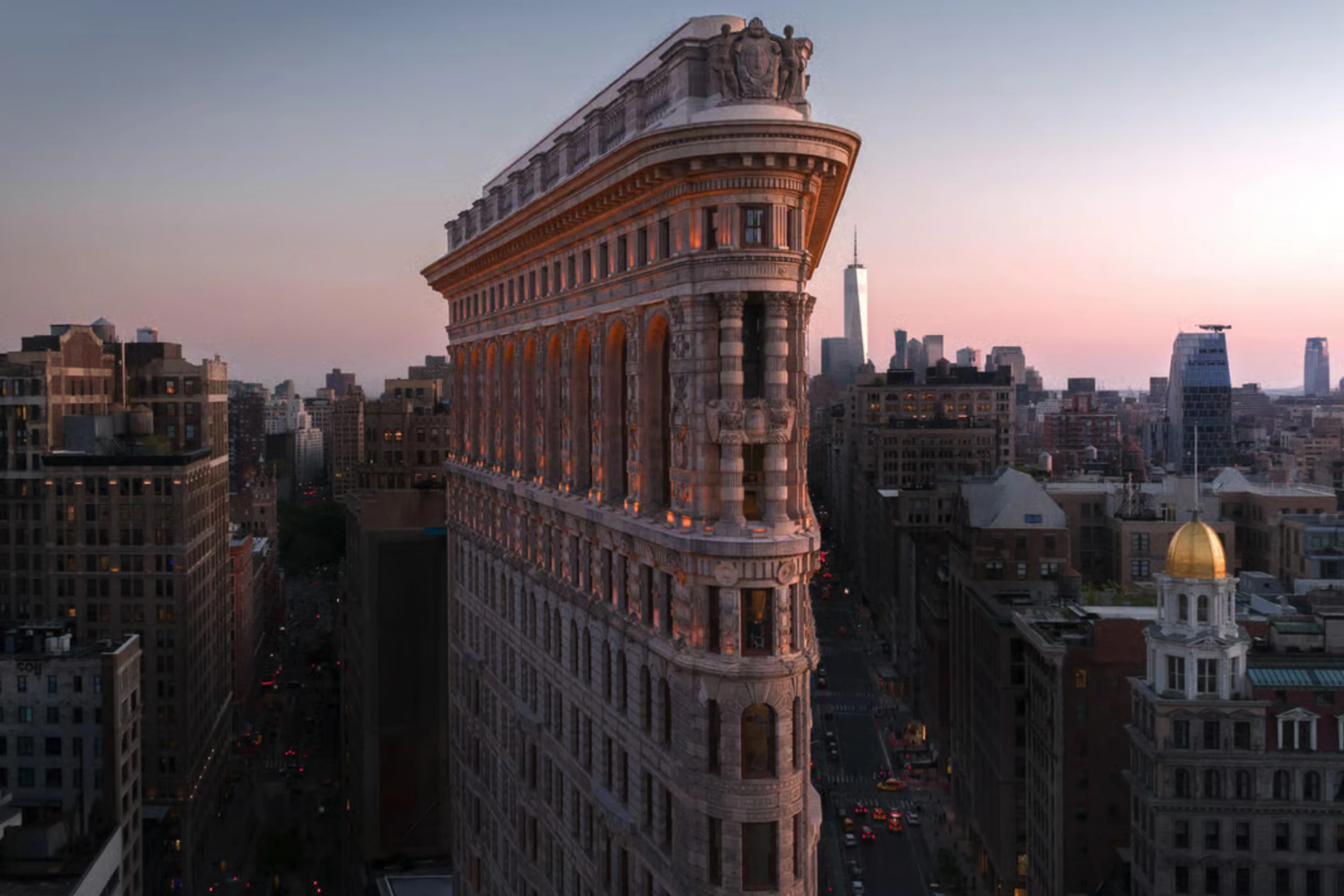
Its narrow prow, shaped by the triangular block beneath it, gave the building its nickname and a profile so striking that many early critics doubted it could withstand strong winds. Instead, it became one of the defining images of the modern city, photographed endlessly and reproduced in films, postcards, advertisements, and paintings.
The building spent most of its life as office space. Over the decades, publishers, small businesses, engineers, architects, and advertising firms occupied its wedge-shaped floors, while a variety of ground-floor retail spaces wrapped around the busy sidewalks below. In 1966, the newly formed Landmarks Preservation Commission (LPC) designated it an individual landmark. It was later added to the National Register of Historic Places and named a National Historic Landmark. Today, it also sits within the Ladies’ Mile Historic District, meaning any exterior alteration remains subject to LPC approval.
The nearly complete residential conversion, led by The Brodsky Organization and The Sorgente Group, will contain 38 residential units, along with storage lockers and wine cellars, as well as three retail spaces on the ground floor. Brodsky enlisted Studio Sofield and AD100 designer William Sofield to reimagine the interiors with the intention of honoring the building’s rich legacy while incorporating elements inspired by original materials uncovered during the restoration process, including historic railings, original ironwork, and marble mosaics. Each half- and full-floor residence features a unique layout, with most offering distinctive views across the Ladies’ Mile and Madison Square Park area.
The ornate Beaux-Arts exterior of terra cotta and limestone is being completely restored and structurally upgraded, a monumental undertaking that has kept the tower shrouded in construction netting for nearly a decade. The offering plan notes that construction is expected to continue for one to two years after the first closings as crews complete amenities, corridors, façade work, and retail build-outs. In recent weeks, as the construction netting has come down, portions of the restored facade have been revealed, rekindling appreciation among many New Yorkers who have not seen the exterior since before the pandemic. Additionally, a new Landmarks-approved exterior lighting scheme illuminates the top five floors and also will soon shine on decorative features on the lower levels, according to the development team.
The Flatiron will operate as a full-service condominium with a 24-hour attended lobby, private storage lockers, wine cellars, and resident amenity spaces integrated into the building’s lower levels, including a swimming pool, exercise room, dedicated Pilates studio, bike storage, and simulator room. Some of the building’s infrastructure will also occupy unusual spaces beneath the sidewalks in city-owned vault areas below grade, including mechanical rooms, storage areas, and portions of the amenity spaces.
The Flatiron is one of the most photographed buildings in the world, despite being only 285 feet tall, tiny compared with modern skyscrapers. Below are 15 surprising things about the Flatiron Building that many people don’t know:
15 Things You might not know about The Flatiron Building
- IT WASN’T ORIGINALLY CALLED THE FLATIRON
When it opened in 1902, the building was officially named the Fuller Building after the George A. Fuller Company that developed it. The public quickly nicknamed it the Flatiron because it resembled a cast-iron clothes iron. Take that "Gherkin" - IT WENT UP INCREDIBLY FAST
Construction took just about a year, extremely fast for a skyscraper at the time (and even for today), thanks to steel-frame construction pioneered in Chicago. - PEOPLE THOUGHT IT WOULD BLOW OVER
Because of its narrow wedge shape and height, critics called it “Burnham’s Folly.” Many believed strong winds would knock it down. The steel skeleton, however, was engineered to withstand four times the expected wind loads. - THE BUILDING HELPED CREATE THE FLATIRON DISTRICT
Before the tower existed, the area was part of the Ladies’ Mile retail district. The building became so iconic that the entire neighborhood eventually took its name from it. Most of the area is designated a historic district, meaning substantial changes to building exteriors need to be reviewed by the Landmarks Preservation Commission. - THE TRIANGULAR TIP IS ONLY ABOUT 6.5 FEET WIDE
At its narrowest point, the famous prow facing Madison Square is only 6 to 6.5 feet wide, helping make it one of the most dramatic building corners in the world. - OFFICES HAD ODD-SHAPED ROOMS
Because of the wedge shape, many interior spaces were triangular or trapezoidal. Tenants often struggled to place desks and furniture. Likely the reason the building has been a prime candidate for a residential/hotel conversion for several decades. - THE BUILDING WAS MODELED AFTER A CLASSICAL COLUMN
Architect Daniel Burnham divided the facade into three vertical sections: base, shaft, and capital, mimicking the proportions of a Greek column. Many buildings of the Chicago School follow this template, such as Louis Sullivan's Bayard Building in NoHo. - THE WINDS MADE WOMEN’S SKIRTS FLY UP
Strong winds created by Broadway and Fifth Avenue converging there would whip around the building. Men used to gather hoping to see women’s skirts blow upward. Police frequently chased them away, supposedly shouting “23 skidoo!” which helped popularize the phrase. - THERE WERE ORIGINALLY NO WOMEN’S RESTROOMS
The building initially had bathrooms only for men. Early 20th-century office culture was still overwhelmingly male. Later, management designated alternating floors for men and women restrooms on odd-numbered floors. - THE VERY TOP OFFICES WERE THE MOST DESIRABLE
Even though they were small, the pointed prow offices were highly coveted because they offered spectacular views down Fifth Avenue. - THE BUILDING HELPED DEFINE EARLY SKYSCRAPER STYLE
It’s one of the oldest surviving steel-frame skyscrapers in New York, representing a transition from masonry buildings to modern towers - IT ONCE HAD A SECRET RESTAURANT AND CLUB
In the early 1900s, a restaurant and social club operated inside the building, popular with publishers and business leaders. - FAMOUS PHOTOGRAPHERS MADE IT LEGENDARY
Some of the most famous early architecture photographs in history feature the Flatiron, including Edward Steichen’s moody 1904 image taken in snow and fog. - FOR DECADES IT WAS DOMINATED BY ONE TENANT
The publishing company Macmillan occupied a huge portion of the building for much of the 20th century before leaving in 2019. - IT’S BECOMING APARTMENTS AND RECEIVING ARCHITECTURAL EXTERIOR LIGHTING FOR THE FIRST TIME IN ITS HISTORY
After more than a century as offices, the building is finishing its conversion into high-end condos, marking the first time people will actually be able to live the building. It joins other Madison Square-are conversions such as the Sohmer Piano Building, The International Toy Factory Building (10 Madison Square West), and 212 Fifth Avenue.