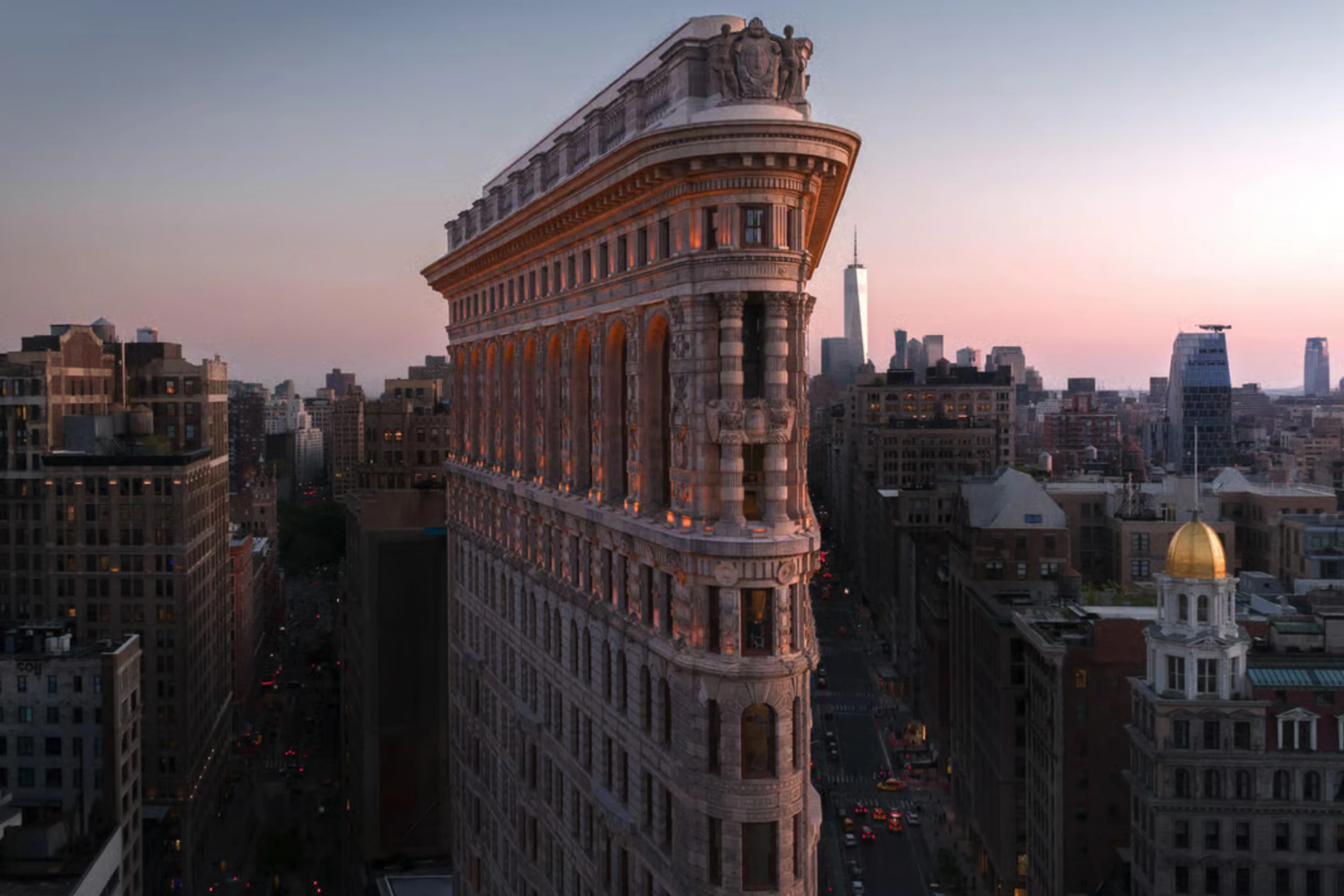
Living Inside The Icon
Anna Casotti | Posh Magazine
There are buildings that become indispensable emblems, embodying the very soul of a city—and in the heart of Manhattan, the Flatiron Building stands as its most recognizable symbol. Elegant and soaring, it has pierced the New York skyline with its 22 floors for more than 120 years, since its completion in 1902 under the name Fuller Building. Nomen omen, as the ancient Romans used to say: its unmistakable triangular silhouette, dominating the intersection of Fifth Avenue and Broadway, soon earned it the affectionate nickname flat iron—a “clothes iron”— in reference to its unusual and revolutionary form. Conceived by Daniel Burnham, one of the leading figures of the Chicago School—celebrated for popularizing Beaux-Arts architecture and for his transformative ideas in urban planning (“Make no little plans,” he famously declared)—the building was originally commissioned as a showpiece by the Fuller Company, then New York’s foremost construction firm. Light and slender, it defied convention, masterfully redefining the relationship between space and architecture. Few could have imagined that it would become a New York icon—an almost constant presence in cinema, in the photographs of artists such as Alfred Stieglitz, and in the daily gaze of passersby. Over time, this emblematic structure has housed basement restaurants, offices, publishing houses, creative studios and toy companies. Today, for the first time in its history, it has been transformed into one of the most coveted addresses dedicated to luxury living. The cultural soul of Manhattan thus opens a new chapter through an intervention that is both ambitious and exquisitely sensitive. Preserving the Flatiron’s identity was an unquestionable guiding principle—first and foremost its terracotta façade, restored with meticulous dedication. More than 1,000 windows were replaced by hand, the ornamental terracotta elements were carefully recreated through artisanal craftsmanship, and the historic upper cornice, approximately six feet tall, has been returned to its original splendor. In a subtle dialogue between history and contemporaneity, the interior design—led by Studio Sofield under the creative direction of William Sofield—translates the building’s timeless elegance into a collection of private residences, each distinct from the other, interpreting a vision of discreet and sophisticated luxury living. “Very few buildings in the world elicit an emotional response like the Flatiron Building,” says William Sofield, Designer and Founder of Studio Sofield. “Reimagining this iconic landmark as residences has been an exciting and deeply meaningful experience—one we approached with great care and respect.” The Flatiron’s irregular floor plan thus becomes the cornerstone of the entire project: a defining feature that makes every home unique, conceived through unexpected angles, oblique perspectives and unparalleled views. The result is 38 private residences, each with an entirely one-of-a-kind layout, unfolding across generous surfaces—from 280 square meters to duplex residences exceeding 680 square meters—including penthouses and full-floor apartments offering breathtaking skyline views. “What was modern about the Flatiron Building in 1902 is still what is modern about it today. That is a rarity,” continues Sofield. “We fully embraced the building’s archaeology in designing the next chapter of its story. The reimagined interiors reflect a deep love of craftsmanship, materiality and history. We carefully considered what kind of design language would best honor the site’s integrity and its role within the city. Every material, color palette and detail was chosen with that intention in mind.” Natural materials take center stage throughout the interiors: fine woods, carefully selected stones and satin-finished metals imbue the spaces with refinement and harmony, sustaining an ongoing dialogue between the Flatiron’s history and its renewed vision of living. “Our designs embrace the modernity of the building’s timeless architecture and design while incorporating contemporary elements inspired by original materials uncovered during the extensive, multi-year restoration process,” explains Sofield. “Historic cast-iron railings, marble mosaic flooring and original ironwork were among the materials that guided our creative process and served as a crucial starting point for imagining what the interiors could become.” Natural light floods every space, inviting residents to immerse themselves in the Flatiron’s most precious privilege: its views. From floor-to-ceiling windows, the eye drifts across scenes of exceptional beauty—Fifth Avenue, Broadway, and the green oasis of Madison Square Park. Between lounges, shared amenities, private pools and spaces dedicated to wellness and fitness, the essence of this Manhattan icon is felt in every detail. Its Renaissance thus becomes a true cultural gesture—a refined narrative spanning more than a century, now illuminated by new light and renewed memory.