The Flatiron reborn: a pie-shaped slice of sky-high living
Edwin Heathcote - Financial Times
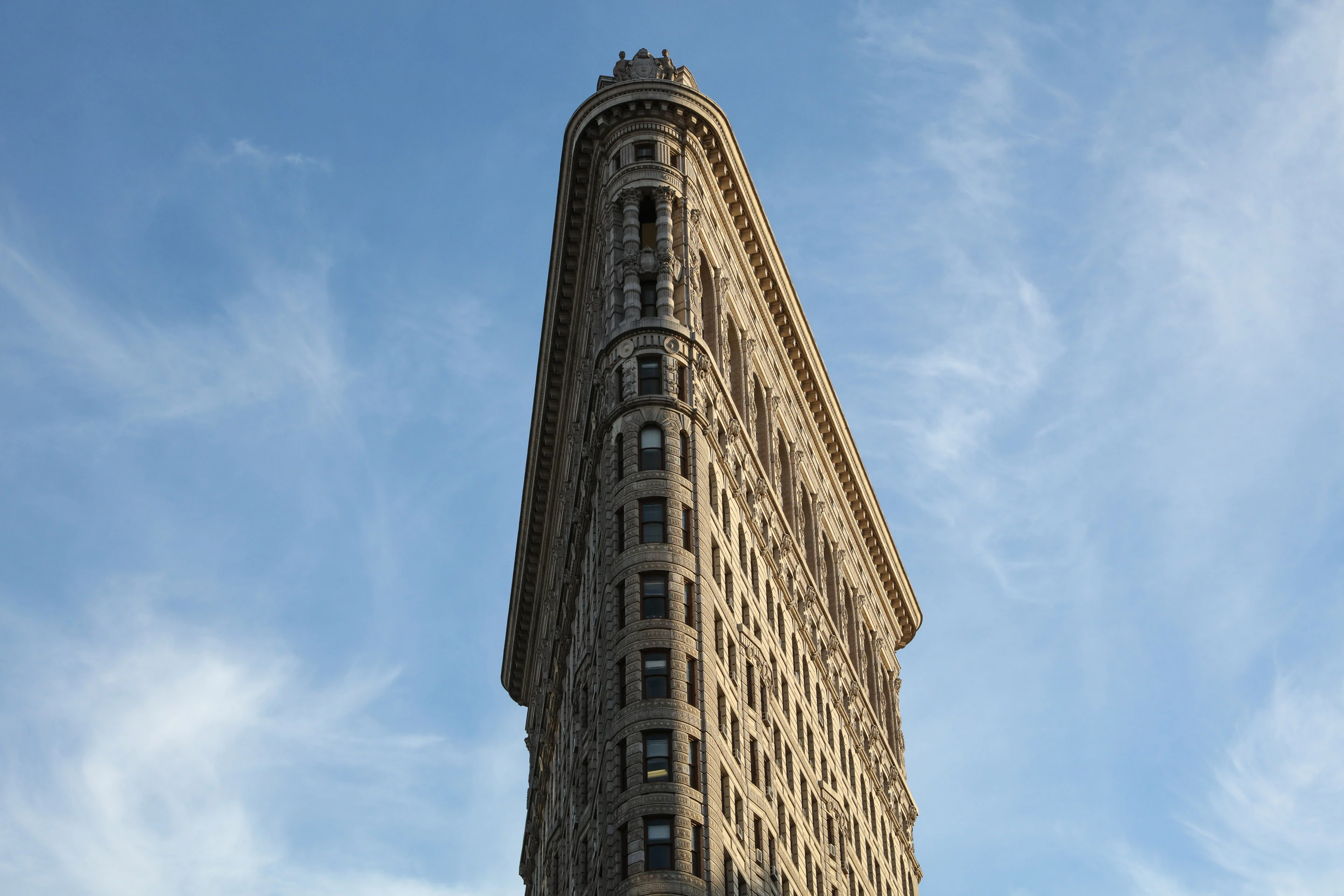
Shortly before he died in 1946, the photographer Alfred Stieglitz remembered taking a shot of one of one of New York ‘s most famous structures, in 1903. “I suddenly saw the Flatiron Building as I had never seen it before,” he said. “It looked, from where I stood, as if it were moving towards me like the bow of a monster ocean steamer, a picture of the new America which was in the making.” There had been snow and Stieglitz’s photo showed this looming, enigmatic edifice as a standalone object emerging from the white landscape, the dark silhouette of a tree blocking out part of the building. The following year his friend Edward Steichen also took a photo of the building, originally created as the headquarters for the construction firm Fuller Company. Moody, atmospheric and in colour, the picture made it look like a “nocturne” by Whistler; alongside the boughs of a tree, coachmen were in top hats. A print of this image became the second most expensive photo ever sold; it hammered down for $11.84mn at Christie’s in 2022. This charismatic extruded door wedge of a tower has become an indispensable element of Manhattan’s iconography and self-image. And now, slice-of-pie-shaped apartments are available to buy. One of the smaller of the 38 apartments, with three bedrooms, can be bought for a little less than the price of that photo. The building, which for all its life has accommodated a mix of commercial uses, is succumbing, as are so many of Manhattan’s most characteristic structures (from the Woolworth Building and One Wall Street to 100 Barclay Street), to residential conversion.
When it opened, the Flatiron’s 22 storeys of steel skeleton dressed in ornate limestone and terracotta cladding were nothing like how we would come to imagine skyscrapers, with their stepped setbacks. It was more like an extruded triangle in a sugar paste confection of classical, beaux arts ornament; people would come to simply stare up. The building had its own power plant too, a harbinger of modernity. In the basement there was a 1,500-seat restaurant. It had one of the first bars to welcome women on their own and, from 1911, the city’s first jazz bar outside Harlem to allow black musicians to play, bringing ragtime to the rest of the city. The Taverne Louis, meanwhile, was among the rare establishments to welcome gay men. The bacchanalia was crushed by prohibition. The Flatiron was the vision of Daniel Burnham, a Chicago architect and pioneer of skyscrapers who designed, among other things, the sublime Reliance Building (1890-95), the vast World’s Columbian Exposition of 1893, and London’s Selfridges (1909). Its steel-framed structure meant that its walls did not need to be load-bearing, leaving more space inside, even at the slender prow.
“The word ‘iconic’ is so overused these days but here, at least, it is completely appropriate,” says architect and historian Robert AM Stern. “It defines the pivot between Downtown and Uptown Manhattan. And it looks in its setting exactly as it did more than a century ago.” Intriguingly, for a building that seems so much to define its city, “it is symbolic of New York but it’s not really a New York building, it’s a Chicago building,” says Carol Willis, director of the city’s Skyscraper Museum. “And not just because of its architect, Burnham, but because of its form, its tripartite shape, with a base, shaft and cornice, like Chicago buildings. But if Chicago buildings have the look of a [inflated] Renaissance palazzo, what makes this different is the site, which is very New York. That triangle. It means that the building becomes more of a column than a palazzo, it’s so slender.”
There are 38 apartments in the building, with two on most floors, but there are also two entire-floor apartments (priced around $50mn each). Nothing here is cheap. The slim floor pan means there are windows and views galore, with none of the claustrophobia you find in new-build towers with their large floor-plates and dark centres. It turns out that the slim slice of pie is a very good shape for living.
Two of the apartments end in small round balconies, which will surely be some of the most sought-after and intimate spaces in the city, the whole energy of Broadway squeezed between two chunky, ribbed columns into a little circular locus. “In 1966, a year after the Landmarks Commission was formed,” Willis tells me, “the Flatiron was landmarked. It was a no-brainer. But most of the other buildings were municipal, owned by the city, so no one cared that much. But this was commercial. That was different. It preceded the landmarking of the Empire State Building by 30 years.”
However, until recently, the Flatiron had not been much loved inside. A series of reconstructions had left it with a generic commercial interior. “It had been mutilated by dropped ceilings and strip lights and it had become a warren of small rooms,” Sofield says.
He is attempting to re-enchant the Flatiron with some of its original detail and elegance. The street-level spaces will become residents’ lobbies and retail spaces; more like they might have been when it opened. A long-defunct revolving door at that prominent corner is being remade so the Flatiron can be entered from the most logical point. He has recycled bits of the old building; balustrades are revived as washbasin legs and there are new hand-clipped mosaic floors (each apartment has its number before the threshold). “Where there is evidence of what came before, we’ve tried to recreate it,” he says. It has been an epic task. Daniel Brodsky, managing partner of building owners The Brodsky Organization, tells me: “There’s always hesitation taking on a landmark building like this. But there’s also an advantage. It has an incredibly special character that makes it worth the pain. Every design decision needs Landmarks to approve it; [architects] Beyer Blinder Belle worked for two years just getting approvals. But when you finish you have something very unique.” We’re sitting in the project office looking over at the Flatiron. Brodsky points across the way and says: “That’s Jeff Bezos over there, he put four apartments together for $150mn. There’s a group of wealthy people who want to be in a convenient place; good transportation, the best restaurants in the city, the park . . . it’s a very easy place to live. You’re surrounded by coolness.”
A couple of decades ago you would not have said that. The neighbourhoods reinvented as Flatiron and NoMad (North of Madison) were shabby, the streets a dirty grid of wholesalers and shuttered stores. When the Flatiron was built, this was the heart of the Ladies’ Mile, the deluxe shopping stretch along Broadway. But it was also, at various times, a toyshop neighbourhood, and a hub of photo processing labs and camera stores (hence, in part, Steiglitz and Steichen), as well as the city’s original Tin Pan Alley. “The neighbourhood was totally debased by the 1980s,” sociologist Sharon Zukin tells me. “There were a few hotels housing homeless people, and a long run of wig stores. You wouldn’t really have a reason to go there.” But “it became one of the first loft living neighbourhoods in the city, even though everyone always thinks of SoHo,” continues Zukin, who wrote her pioneering book Loft Living in 1983. “Then it became one of the city’s first tech districts with start-ups and [venture capital funds]. I was a little surprised the Flatiron wasn’t turned into a huge tech building.” Probably it was just too low tech. White hot when it opened, with hydraulic elevators and a 21st-storey viewing deck, it had become defunct. Twenty years ago the idea of spending $50mn on an apartment in this neighbourhood would have sounded insane (even talking into account rapid inflation). To many, of course, it still does, but for those who can afford it: what price can you put on living in one of the most recognisable buildings in New York? When Alfred Stieglitz’s father asked him why he had photographed this “hideous building”, the photographer replied: “That is the new America. It is to America what the Parthenon is to Greece.”